
7 Anti-Inflammatory Foods I Add to Almost Everything I Cook
These are the 7 anti-inflammatory foods I add to almost every meal — real ingredients, simple habits, and why they matter for blood sugar too.
Hope Sinclaire
5/28/20265 min read
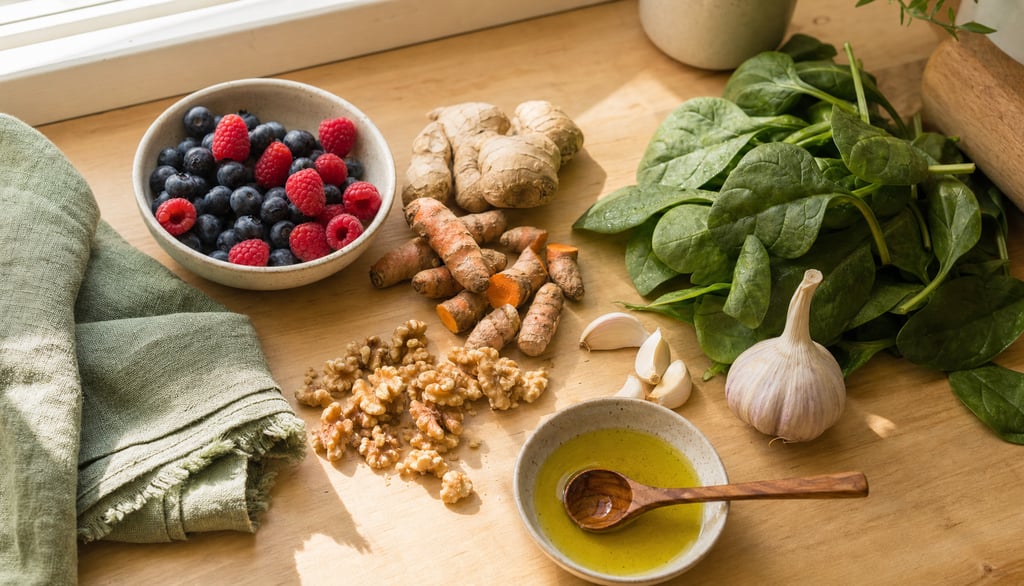
7 Anti-Inflammatory Foods I Add to Almost Everything I Cook
I didn't set out to become someone who thinks about inflammation.
When I was first navigating my blood sugar diagnosis, I was laser-focused on glucose — what spiked it, what didn't, what I could eat, what I should avoid. Inflammation wasn't really on my radar. It felt like a buzzword, honestly. One of those things wellness people say.
And then I started noticing a pattern. The foods that seemed to help my blood sugar the most were also the ones showing up on every anti-inflammatory list I came across. Turmeric. Olive oil. Leafy greens. Berries. There was clearly something here worth paying attention to.
What I've come to understand — in a very real, lived-in way — is that chronic low-grade inflammation and blood sugar dysregulation feed each other. When your body is inflamed, insulin doesn't work as efficiently. When blood sugar is unstable, it creates more inflammation. It's a cycle, and breaking it from both ends makes a real difference.
These are the 7 foods I've quietly folded into almost everything I cook. Not as a protocol. Not as a checklist. Just as ingredients that became part of how I eat — and that I believe have made a genuine difference.
1. Turmeric
Turmeric is the one I reach for most consistently, and it's earned that place.
The active compound in turmeric — curcumin — is one of the most well-researched natural anti-inflammatory agents there is. The research on it and blood sugar regulation is genuinely impressive, and my own experience has backed that up.
I add turmeric to scrambled eggs, soups, roasted vegetables, grain dishes, and golden milk. I keep a jar on the counter, not in the back of the spice cabinet, because out of sight means out of mind. The trick I learned: always add a small pinch of black pepper alongside it. Piperine, the active compound in black pepper, increases curcumin absorption by up to 2,000 percent. That detail changed how I use it.
It doesn't make everything taste like curry if you use a light hand. It just quietly does its work.
2. Extra Virgin Olive Oil
I stopped being afraid of fat a long time ago, but olive oil was the first fat I learned to actually lean into.
Extra virgin olive oil is rich in oleocanthal, a compound with anti-inflammatory effects similar in mechanism to ibuprofen — and it's one of the most blood-sugar-friendly cooking fats there is. It doesn't spike glucose, it supports cell sensitivity to insulin, and it adds genuine flavor to everything.
I use it to roast vegetables, as a base for sautéing, drizzled over salads, and spooned over cooked grains or fish. I don't measure it. I just use it freely in place of vegetable oils and butter, and I've never looked back.
The key is quality. Extra virgin, cold-pressed, in a dark bottle. The cheap stuff in a clear plastic jug is not the same thing. It doesn't have to be expensive — just real.
3. Garlic
Garlic is one of those foods that does so many things quietly that I'd feel its absence long before I'd consciously notice its presence.
It's anti-inflammatory. It supports healthy cholesterol and blood pressure. Some research suggests it can improve insulin sensitivity. And it makes almost everything taste better, which is not a small thing when you're trying to eat in a way you can sustain.
I add garlic to nearly every savory dish I make — roasted with vegetables, sautéed as a base for soups and stews, minced raw into dressings and dips. When I don't have fresh, I use the jarred kind. Imperfect consistency still beats no garlic at all.
One thing worth knowing: letting chopped or crushed garlic sit for about ten minutes before cooking activates its beneficial compounds more fully. A small habit that costs nothing.
4. Leafy Greens
Spinach, kale, arugula, chard, collards — I eat some form of leafy green every single day, and I genuinely believe this is one of the most impactful things I do for my health.
Leafy greens are rich in magnesium, a mineral that plays a direct role in blood sugar regulation and that a significant portion of people with Type 2 diabetes are deficient in. They're also loaded with antioxidants, fiber, and anti-inflammatory compounds that work quietly in the background to reduce systemic inflammation.
I add spinach to scrambled eggs, tuck arugula under everything I'd normally eat plain, blend kale into smoothies, and keep a bag of mixed greens in the fridge specifically for throwing into whatever I'm making. They wilt down to almost nothing in a warm pan, which makes it easy to add a huge amount without it feeling like a salad-for-dinner situation.
If there's one category of food I'd put at the center of anti-inflammatory eating, it's this one.
5. Berries
Blueberries especially, but also raspberries, strawberries, and blackberries. I eat them at breakfast most days, but they show up in other places too — stirred into plain yogurt for a snack, added to a smoothie, eaten straight from the container standing at the kitchen counter.
Berries are one of the best blood-sugar-friendly fruits because their fiber content slows glucose absorption, and their phytochemicals — particularly anthocyanins, which give them their deep color — are powerful anti-inflammatory compounds. Research specifically on blueberries and blood sugar regulation is quite promising.
They also satisfy sweet cravings in a way that doesn't derail anything. Which, after learning to navigate a world full of sugar, is something I genuinely appreciate.
6. Ginger
Ginger is turmeric's quieter companion, and it works beautifully alongside it.
Fresh ginger has well-documented anti-inflammatory and antioxidant properties, and there's growing research around its effect on blood sugar and insulin sensitivity. I use it in stir-fries, grated into dressings and marinades, steeped into hot water for a simple morning drink, and added to smoothies for a warm, slightly spicy note.
Fresh ginger is my preference — a knob of it keeps in the fridge for weeks or in the freezer even longer. But ground ginger in the spice cabinet works too, especially in warm dishes and teas. I don't treat it as medicine I'm taking. I just cook with it because it tastes good and it does good.
7. Walnuts
I keep a small jar of walnuts on my kitchen counter, and I add them to things constantly — yogurt, salads, oatmeal, grain bowls, eaten by the small handful as a snack.
Walnuts are the nut highest in omega-3 fatty acids, which are among the most well-researched anti-inflammatory nutrients we have. They also contain polyphenols, vitamin E, and magnesium. Studies have specifically linked regular walnut consumption to improved blood sugar control and reduced inflammation markers.
What I love about them practically is that they add texture and satiety to almost anything. A bowl of yogurt and berries with a tablespoon of walnuts is a very different, much more sustaining meal than the same bowl without them.
A small handful — roughly an ounce — is plenty. You don't need a lot for the benefits to add up.
It's Not About Being Perfect — It's About Adding In
The shift that helped me most wasn't removing things I loved. It was adding things that genuinely support my body, consistently, over time.
Turmeric in the eggs. Olive oil on the vegetables. A handful of walnuts in the yogurt. Garlic in basically everything. None of these are dramatic. Together, they quietly change what your body is working with every single day.
That's been the whole approach for me. Small, real additions. Consistently. Over time. And gradually — in a way that doesn't feel like a diet — things shift.
Start Your Own Gentle Reset
If you want a simple, structured way to start incorporating habits like these into your daily routine, my free Feel Better in 14 Days guide is a gentle, no-restriction 14-day reset built around exactly this kind of approach.
👉 Download your free copy here — real food, real habits, real support for your blood sugar.
This post is based on my personal experience and is intended for general informational purposes only — not as medical advice. Always work with your healthcare provider on your individual health journey.
Affiliate Disclosure: Some links on this site are affiliate links, meaning we may earn a commission at no extra cost to you. We only recommend products we trust.
Contact us at:
© 2025. hoperenewlifestyle.com All rights reserved.

