
What I Eat in a Day to Keep My Blood Sugar Stable (Without Obsessing Over It)
A real Tuesday's worth of meals, built around one quiet question: how do I want to feel at 3pm? No diets, no rules, no superfoods.
Hope Sinclaire
7/15/20268 min read
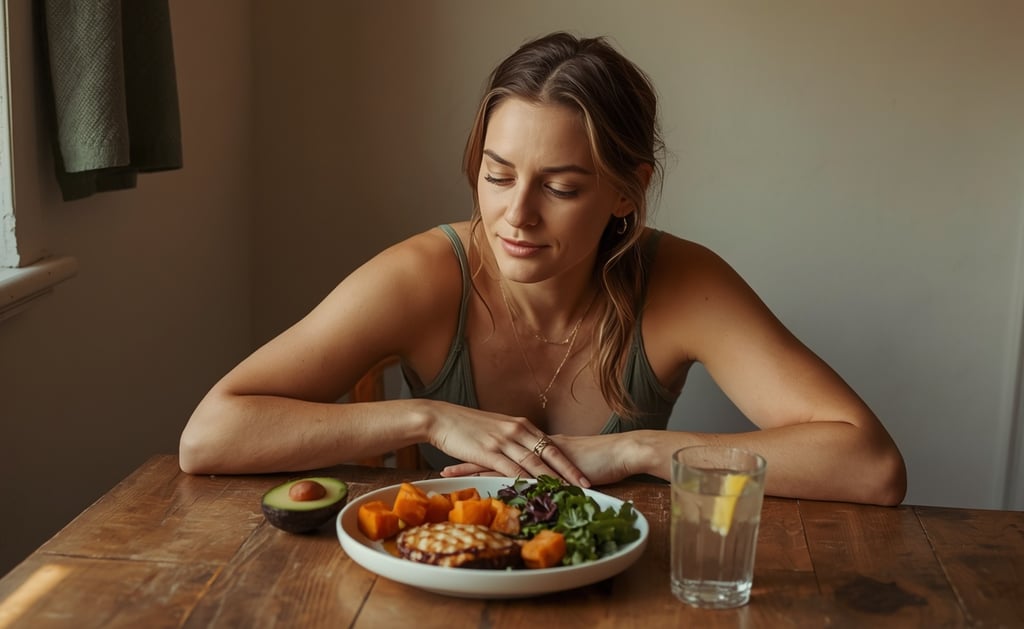
I get asked this question more than almost any other: "But what do you actually eat in a day?"
Not what I ate on day three of some reset that didn't last. Not what I ate when I was white-knuckling through a plan. What I actually eat, on a real Tuesday, when life is just regular life.
So I'm going to walk you through it. Not because my plate is special. But because I think we've all been sold this idea that "eating for blood sugar" means eating like a robot — measuring everything, cutting everything out, never enjoying a piece of toast again.
That's not it. That's never been it.
What I eat is built around one quiet question: how do I want to feel at 3pm?
Not at 3am when I'm planning the perfect day in my head. At 3pm, when the kids are loud, or work is dragging, or I haven't moved from my desk in four hours. How do I want my body to feel then?
When I started eating with that question in mind, everything changed. I stopped chasing the cleanest plate and started chasing the steadiest afternoon. And the plate I landed on — the one I'm about to walk you through — is not the plate of someone who is "on a diet." It's the plate of a woman who got tired of the 3pm crash and built her way out, one small choice at a time.
A note before we start
I am not a doctor. I am not a nutritionist. I am just a woman who paid attention, over about a year, to the way different foods made me feel — and quietly rearranged my days around the ones that helped.
If you've been diagnosed with prediabetes, insulin resistance, or any other blood sugar condition, please work with your own care team. What I'm sharing here is what worked for me. It is not medical advice. It is the lived experience of someone who was tired of the 3pm crash, and who figured out, slowly, that the crash wasn't inevitable.
The question that changed everything
The 3pm question.
That is the only "rule" I live by. I don't count macros. I don't track points. I don't weigh my food. I don't follow a plan that tells me what to eat on Monday versus Thursday. I just ask myself, every time I sit down to eat — how do I want to feel at 3pm?
It sounds almost embarrassingly simple. But it has rearranged my entire relationship with food in a way no diet ever did, because it puts me back in the driver's seat. I'm not eating for the future version of me who wanted to lose ten pounds. I'm eating for the version of me who has to live in this body for the rest of the afternoon, and who is honestly more interested in feeling good than looking a certain way.
The plate I eat from is a direct answer to that question.
Breakfast — the one that quietly changed my whole workday
For years, I treated breakfast like a thing I had to get through so I could have coffee. Toast with jam. A granola bar. A bowl of "healthy" cereal that was, once I read the label, mostly sugar. I told myself I "wasn't a breakfast person," and I believed it, because by 10am I was starving and by 3pm I was wrecked and I didn't connect the two.
The shift wasn't adding a complicated breakfast. The shift was adding protein. Real protein. Before anything else.
What that looks like on a real morning:
Two eggs, scrambled or fried in a little olive oil, with a slice of whole-grain toast
A bowl of plain whole-milk Greek yogurt with a handful of nuts and a few berries
Leftover chicken from the night before, eaten standing at the counter while the coffee brews (this sounds weird, it is amazing)
A piece of cheese and an apple when I genuinely cannot be bothered to cook
A piece of smoked salmon, cucumber, and a boiled egg when I want breakfast to feel like a small luxury
The pattern isn't fancy. It is just: protein first, then carbs, then fruit, then coffee. Every time. Even when it's just a piece of cheese and an apple.
I am not going to pretend this was an instant transformation. The first week I didn't notice much. By the second week I noticed I wasn't thinking about the snack drawer at 3pm. By the third week I realized I had walked past the coffee machine at 2:45 and not even seen it. I didn't white-knuckle past it. I just didn't see it. My body wasn't asking for the emergency rescue it had been asking for every afternoon for years.
Lunch — the meal I stopped eating at my desk
For about a decade, I ate lunch at my desk. Standing up sometimes. In the car sometimes. In front of a screen, almost always. I told myself I was "too busy" to take a real lunch break, and the lunch I ate was almost always an afterthought — a wrap, a bowl from the place downstairs, whatever was in the fridge that I could eat in four minutes between meetings.
What I have learned, slowly, is that how I eat lunch matters as much as what I eat for lunch. The state I'm in when I eat — rushed, stressed, half-looking at a screen — has a real effect on how my body uses the food. I don't fully understand the science of it, and I don't need to, because the felt experience has been enough to change my behavior.
What lunch looks like now:
A piece of protein (chicken, salmon, canned tuna, hard-boiled eggs, leftover anything)
A big handful of something green (spinach, arugula, kale, whatever is in the fridge)
Half an avocado or a tablespoon of olive oil — fat alongside the protein, it slows the whole meal down
A complex carb if I want one — sweet potato, quinoa, a slice of sourdough
Something crunchy and fresh — cucumbers, peppers, snap peas, radishes
I try, when I can, to actually sit down to eat it. At a table. Without my phone. Even ten minutes. The difference in how I feel at 2pm, when I've eaten sitting down and present, versus how I feel at 2pm when I've inhaled something at my desk — it is not subtle.
Afternoon — the moment I stopped trying to power through
This is the moment most of us are trying to fix. The 3pm dip. The 2:45 coffee run. The snack drawer raid. The "I cannot keep my eyes open" feeling that sends us straight to the vending machine or the corner store.
I have spent years trying to fix this moment from the inside. More coffee. A "healthier" snack. A walk to the kitchen and back. A five-minute meditation. A small energy drink I told myself was fine.
What I finally understood is that the 3pm moment is rarely about 3pm. It is about everything that came before. It is the receipt for breakfast and lunch, and for sleep the night before, and for how hydrated I am, and for whether I have moved my body in the last 24 hours.
When I eat a real breakfast with protein, and a real lunch with protein and fat and a green thing, and I have had water throughout the day — the 3pm moment is just a moment. It is not a crisis. I might be a little tired. I might want a cup of tea. But I don't feel like my body is asking me for emergency help.
When that happens, what I reach for in the afternoon is:
A handful of nuts and a piece of fruit
A small piece of cheese
A hard-boiled egg I made the night before
A few squares of very dark chocolate, eaten slowly
A cup of herbal tea or a second cup of coffee, depending on the day
An apple with a tablespoon of almond butter
These are not magic foods. They are just the foods I have noticed, over time, that don't spike me and crash me an hour later.
Dinner — the meal I stopped rushing
Dinner, for me, used to be the meal I cooked the fastest, ate the fastest, and felt the worst after. I would cook something "healthy" at 7pm, eat it standing at the counter while I cleaned up, and then wonder why I was starving again at 9:47pm.
Dinner now looks different in two ways. The plate is different, and the way I eat is different.
On the plate:
A piece of protein, always. Chicken, fish, beef, lamb, tofu, beans — anything. About the size of my palm.
A generous serving of vegetables, cooked in olive oil, seasoned with salt, lemon, and herbs. Roasted, sautéed, steamed — whatever I have time for. Broccoli, Brussels sprouts, asparagus, zucchini, greens of every kind.
A starch if I want one. Sweet potato, white rice, a piece of sourdough, a small portion of pasta. Carbs are not the enemy. Carbs at the end of the day, with protein and fat alongside them, do not wreck me the way they used to when I was eating them alone.
A small salad or a pile of something fresh, because I have learned I sleep better when I end the day with something green.
How I eat it:
At the table, if I can manage it
Without a screen, if I can manage it
Slowly enough to notice when I'm full
With a pause before the second helping, because I have learned that the second helping is rarely about hunger
And then — and this is the part that has mattered most — I try to take a walk after dinner. Not a workout. A walk. Sometimes ten minutes, sometimes forty. To the end of the driveway and back. Around the block. Around the neighborhood. The walk is not for burning calories. The walk is for the way I sleep that night, and for the way I feel the next morning. I have come to believe the walk is part of the meal.
What I don't do anymore
I want to name these, because I think the things we stop doing are sometimes more important than the things we start doing.
I don't eat "low-fat" anything. Fat, in the right amount, slows my blood sugar down. It is a friend, not an enemy.
I don't drink my sugar. The green juice, the "healthy" smoothie, the fancy latte — most of them were, once I read the label, mostly sugar in disguise.
I don't eat standing up. Not because standing is bad, but because standing is what I do when I am not giving myself a real meal.
I don't keep "cheat" foods in the house. The willpower was never the answer. The shopping list was.
I don't "earn" my dinner with a workout. I work out because I want to, and I eat dinner because I am hungry, and the two are not in a transaction with each other.
I don't eat dessert every night. Sometimes I do, and it is lovely. But I stopped pretending dessert was a required part of the day.
I don't drink alcohol on weeknights. The two glasses of wine at 8pm that I told myself were "relaxing" were wrecking my sleep, and the sleep was wrecking my mornings, and the mornings were wrecking my whole next day. This one change, more than almost any other, was the unlock.
The 3pm question, one more time
If you are reading this and feeling overwhelmed — I want to slow you down. You don't have to build the whole plate tomorrow. You don't have to change all seven things I just listed. You just have to start asking the question.
How do I want to feel at 3pm?
Then, tomorrow morning, eat one thing with protein in it. Just one thing. Before anything else. See what shifts.
Two weeks from now, you will know.
If you want a starting place
I built the Feel Better in 14 Days plan for the woman who is tired of white-knuckling her way through the week and wants a real starting place. Fourteen days of meals built around blood sugar balance, with ingredients you probably already have, designed to help you feel steadier, more rested, and more like yourself.
It is not a diet. It is not a cleanse. It is the kind of slow, simple shift I have been writing about in this post — packaged, with a shopping list, so you don't have to figure it out alone.
Click here to see what's inside → https://www.hopesinclaire.net
Affiliate Disclosure: Some links on this site are affiliate links, meaning we may earn a commission at no extra cost to you. We only recommend products we trust.
Contact us at:
© 2025. hoperenewlifestyle.com All rights reserved.

